
New Hampshire Financial Literacy Statistics
Dedicated to understanding financial well-being statewide, the New Hampshire Financial Educators Council (NHFEC) compiles research-based data on resident financial wellness. The New Hampshire Council maintains and updates these findings on this webpage for public use. Designed to assist legislators, researchers, and community partners, these data help strengthen advocacy for financial literacy education around the Granite State. Sustained advancement of the financial wellness agenda guides the NHFEC’s work, and reporting these statistics is one component of that guidance.
Cost of Financial Illiteracy Survey
New Hampshirites report that lack of financial knowledge carries a high cost, according to the NFEC’s most recent survey. Participants across the state responded to the single question: “During the past year, about how much money do you think you lost because you lacked knowledge about personal finances?” The results are shown below. Since 2017, the NFEC has conducted this annual survey, consistently revealing that the average individual cost of financial illiteracy approaches or exceeds $1,000 per person – with estimated national losses reaching into the hundreds of billions of dollars each year, and losses in the hundreds of millions across New Hampshire.
Cost of Financial Illiteracy
$0 – $499
$500 – $999
$1,000 – $2,499
$2,500 – $9,999
$10,000 +
Financial Vulnerability in New Hampshire
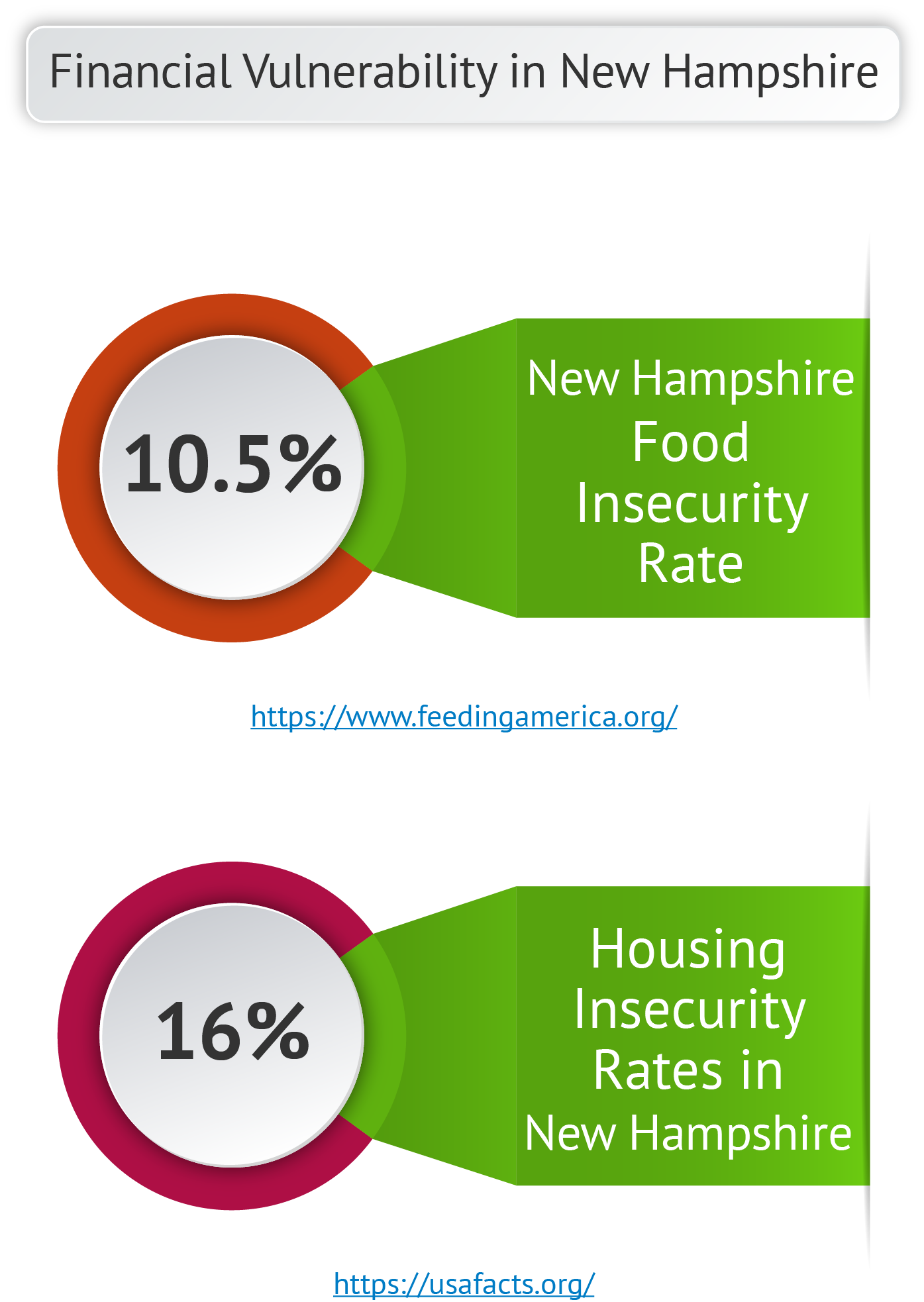
Current measures of financial vulnerability are expressed in terms of food and housing insecurity. Feeding America is a nonprofit agency that tracks hunger across the United States and reports the data at the state level. As of their most recent report, one in every nine New Hampshire residents is facing hunger – a total of 149,820 people (10.5%), of whom 36,160 are children. The organization estimates that an additional $105 million would be the minimum needed each year to meet the food needs of these hungry people.
Housing insecurity affects 2,245 New Hampshirites as of 2024, as reported by the World Population Review (WPR). That number gives the Granite State a homeless rate of 16%, a very slight decrease of –0.01% since 2007. WPR measures total homeless populations in two primary groups: adults or youths who live by themselves, and ones who live in family groups. More than half a million people currently are experiencing homelessness across the U.S.
New Hampshirites’ Financial Situations Characterized
Average Total Consumer Debt
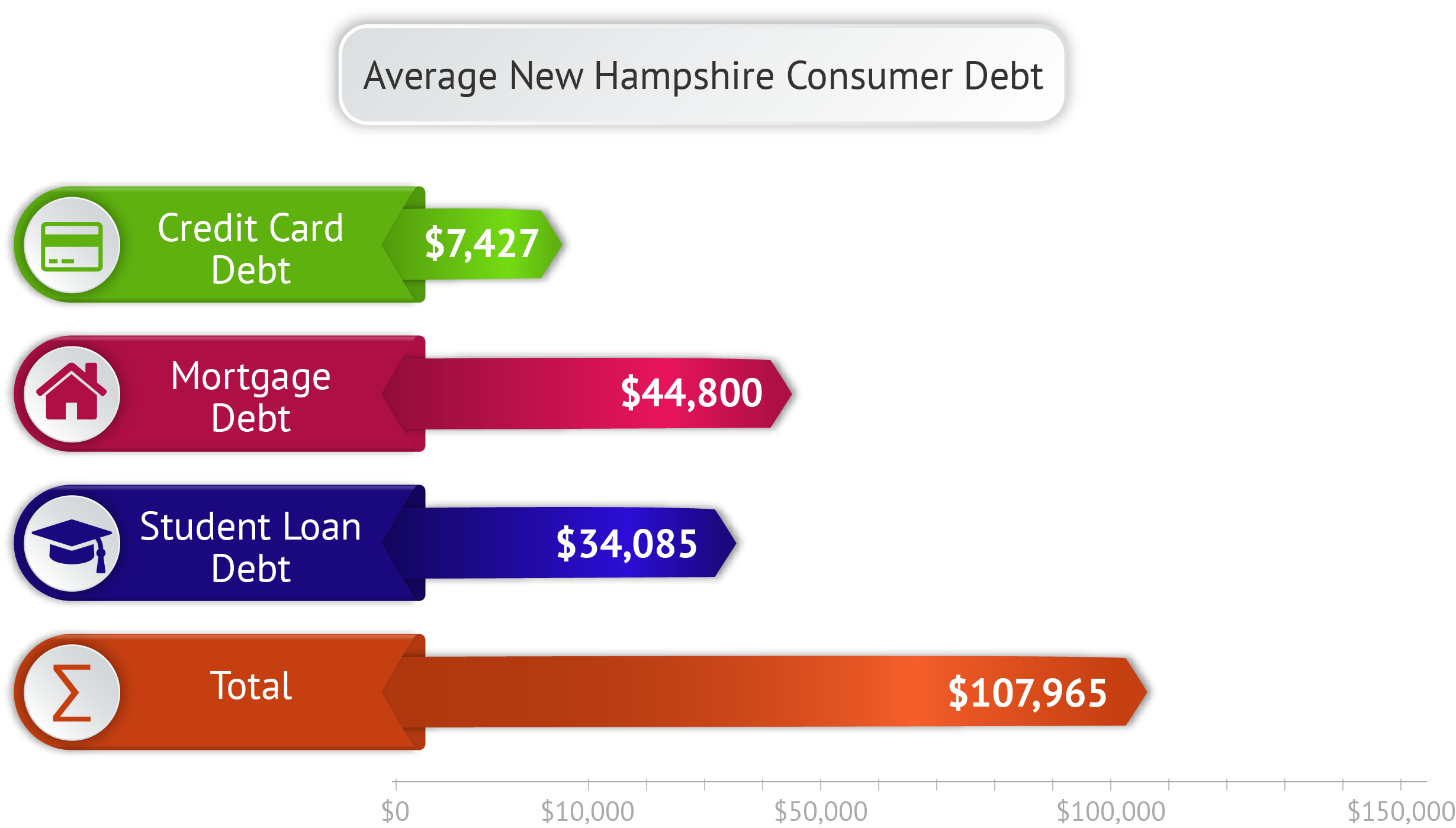
At the end of 2025 total U.S. consumer debt had reached more than $18 trillion, serving to highlight the growing need for financial education in the country. In regards to New Hampshire, data from Experian calculate the average total debt per consumer at $107,965 in 2025, which is even higher than the American average of $104,755. That estimate had remained essentially static since 2024.
Categorizing New Hampshire Debt
When looking more closely at specific categories of debt, we find that New Hampshirites with student loans carry an average balance of $34,085, according to the World Population Review (WPR). Data gathered by WalletHub in 2025 places the average credit card debt per user in New Hampshire at $7,427. And mortgage holders in the Granite State had average mortgage balances owed of $44,800, as reported by another WPR study.
New Hampshire Financial Literacy Legislation and Education Statistics
In the most recent report issued by the National Education Association (NEA) summarizing numbers of schools, teachers, and student enrollments by U.S. state, New Hampshire had 166 operating public school districts in the 2023-2024 school year. The same year, the state’s total student enrollment figure was 165,082 and there were 15,747 teachers serving those students – a pupil-to-teacher ratio of 10.5 to one.
Recent New Hampshire legislation related to school financial education was enacted as HB1671, passed in 2022, which made personal finance a core academic subject under the state’s definition of an adequate public education. This bill required a semester-long course in financial literacy to be offered, with public chapter Ed 306.28 directing each district to “establish and provide competencies and curriculum for personal finance literacy” that covers five standard areas. However, the direction does not set out specific statewide standards or learning objectives, potentially leading to very different learning experiences depending on the local district.